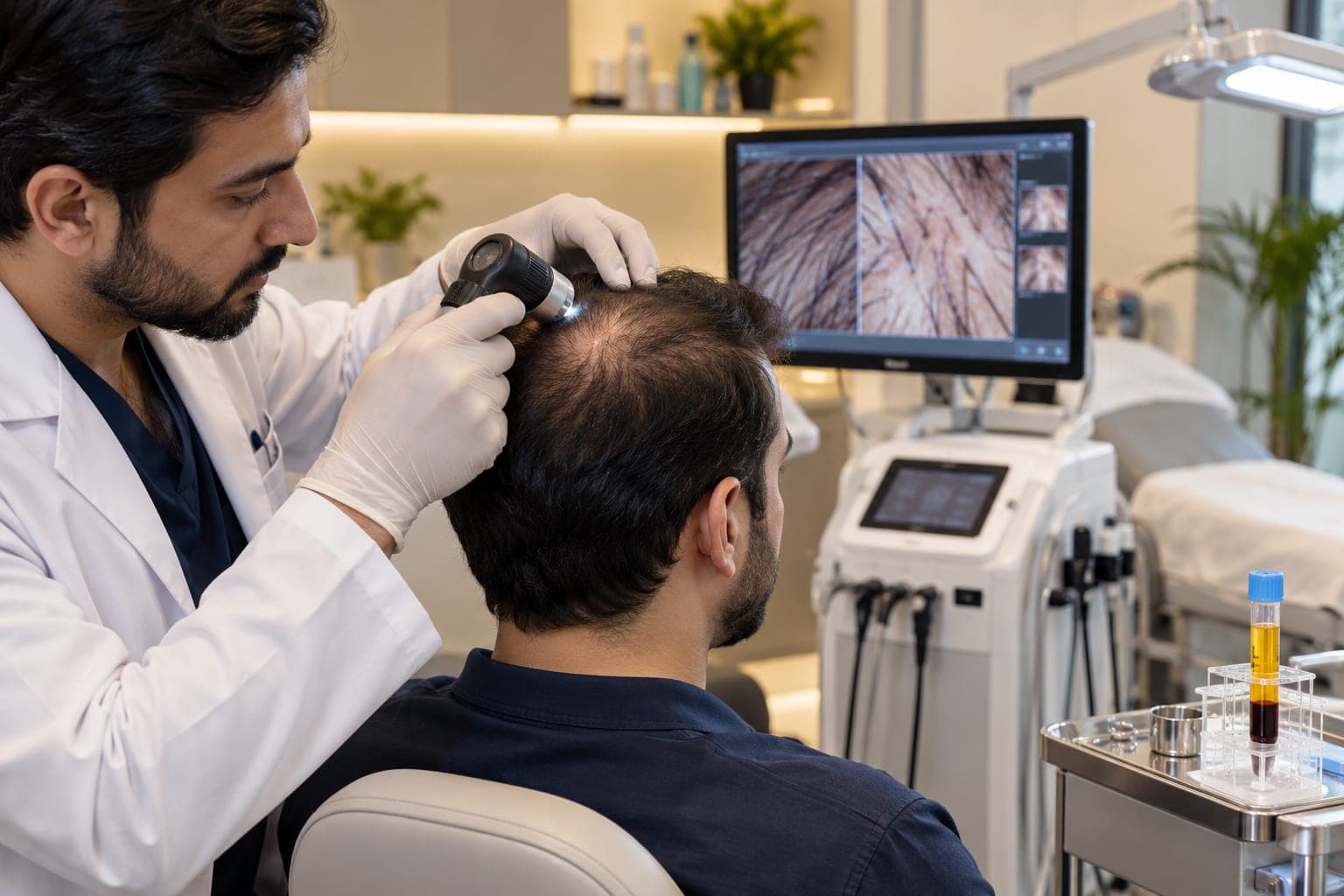

Exosome Hair Treatment in Lahore for hair thinning and hair loss. Learn about benefits, procedure, results, cost, suitability, and how exosome therapy compares with PRP.
Exosome Hair Treatment in Lahore: What You Need to Know
Hair thinning and hair loss can affect both men and women and may become more noticeable over time. While treatments such as PRP and hair transplant surgery are already widely used, exosome hair treatment has gained attention as an emerging regenerative approach for people looking for non-surgical options for hair loss.
Exosome Hair Treatment in Lahore involves applying an exosome-based preparation to areas of the scalp affected by thinning hair. Exosomes are tiny extracellular vesicles that can contain proteins, growth-related signaling molecules, and other biological components involved in cell-to-cell communication. Research into their potential role in hair restoration is ongoing.
However, exosome therapy is still an evolving area of regenerative medicine, and treatment products, preparation methods, evidence, and regulatory status can vary. This is why proper patient assessment and realistic expectations are important before starting treatment.
In this guide, we will explain how exosome hair treatment works, its potential benefits, who may be suitable, the treatment procedure, expected results, number of sessions, cost considerations in Lahore, and how exosome therapy compares with PRP and hair transplantation.
If you are considering exosomes for hair loss in Lahore, understanding the treatment before making a decision can help you choose an approach that is appropriate for your individual type and cause of hair loss.
What Is Exosome Hair Treatment?
Exosome hair treatment is an emerging non-surgical approach being studied for people experiencing hair thinning and certain types of hair loss. The treatment uses an exosome-based preparation that is applied to selected areas of the scalp with the aim of supporting the local cellular environment involved in hair follicle function.
Exosomes are microscopic extracellular vesicles released by cells. They can carry signaling molecules such as proteins, lipids, and other biological components that may influence communication between cells. Researchers are investigating whether these properties could have a role in supporting hair follicle activity and improving the appearance of thinning hair.
Unlike a hair transplant, exosome therapy does not involve removing and implanting hair follicles. It is also different from PRP, which uses the patient's own concentrated platelets and growth factors. The potential effectiveness of exosome treatment can depend on the underlying cause of hair loss, the preparation used, and the individual's response to treatment.
Because research in this area is still developing, exosome therapy should be considered an emerging treatment rather than a guaranteed solution for hair loss.
How Do Exosomes Work for Hair Loss?
Exosome therapy is being studied because exosomes can carry biological signals between cells. These signals may influence processes involved in tissue repair, cellular communication, and the local environment around hair follicles.
When an exosome-based preparation is applied to areas of the scalp affected by hair thinning, the goal is to support the scalp environment and potentially encourage healthier follicular activity. Research has suggested that certain exosome preparations may influence signaling pathways associated with hair follicle growth, although more clinical research is needed to determine how effective these treatments are for different types of hair loss.
The potential effect of exosome therapy may involve several biological processes:
- Cell-to-cell communication: Exosomes can transport signaling molecules between cells.
- Growth-related signaling: Some exosome preparations contain proteins and other factors that may influence cellular activity.
- Scalp environment: Researchers are investigating whether exosomes can support processes involved in tissue repair and the local scalp environment.
- Hair follicle support: The overall objective is to create conditions that may support the function of existing hair follicles.
It is important to understand that exosomes do not create new hair follicles. Their potential role is primarily being investigated in relation to existing or weakened follicles. The outcome can also vary depending on the underlying cause and severity of hair loss, the preparation used, and the individual's response to treatment.
For this reason, a proper assessment of the cause of hair loss should be performed before considering exosome hair treatment.
Potential Benefits of Exosome Hair Treatment
Exosome hair treatment is being investigated as a potential option for people experiencing hair thinning and certain forms of non-scarring hair loss. The potential benefits may vary from person to person and depend on the underlying cause of hair loss, the condition of the existing hair follicles, and the exosome preparation used.
Some of the potential benefits being studied include:
- Supporting existing hair follicles: Exosome-based treatments may help support the biological environment around existing follicles.
- Improving the appearance of thinning hair: Some patients may experience an improvement in hair density or overall scalp coverage if their follicles remain viable.
- Supporting scalp and follicular health: The signaling properties of exosomes are being studied for their potential role in cellular repair and tissue support.
- Non-surgical approach: Unlike a hair transplant, exosome treatment does not require harvesting or implanting hair follicles.
- Potential option for early hair thinning: Patients with relatively early-stage thinning may be considered for regenerative treatments depending on the cause of their hair loss.
- May be combined with other treatments: Depending on the patient's condition, a doctor may consider exosome therapy alongside other evidence-based hair-loss treatments.
It is important to distinguish potential benefits from proven outcomes. Exosome therapy for hair loss is still an evolving field, and clinical evidence is not yet as established as it is for some conventional hair-loss treatments. Patients should therefore discuss realistic expectations, treatment options, and the specific product being used with a qualified healthcare professional before proceeding.
Who May Be Suitable for Exosome Hair Treatment?
Exosome hair treatment may be considered for selected patients experiencing hair thinning or certain types of non-scarring hair loss. However, suitability depends on the underlying cause of hair loss, the condition of the scalp, and whether viable hair follicles are still present.
A consultation and scalp assessment can help determine whether exosome therapy is an appropriate option. It may be considered in situations such as:
- Early or moderate hair thinning where existing follicles are still present.
- Certain cases of pattern hair loss in men or women.
- Patients looking for a non-surgical approach to support existing hair.
- Some patients who want an additional treatment as part of a broader hair-loss management plan.
- Selected patients who may benefit from regenerative treatments after a clinical assessment.
Exosome treatment may be less suitable when the scalp has significant scarring or when hair follicles have been permanently destroyed. In advanced hair loss with extensive areas of follicular loss, a hair transplant may be a more appropriate option.
The cause of hair loss should also be investigated before treatment. Factors such as nutritional deficiencies, thyroid problems, hormonal changes, inflammatory scalp conditions, medications, and other medical conditions can contribute to hair loss. Treating the underlying cause may be more important than choosing a regenerative procedure alone.
A qualified healthcare professional should assess the patient's history, scalp condition, hair-loss pattern, and treatment goals before recommending exosome hair therapy.
What Happens During Exosome Hair Treatment?
The exact technique used for exosome hair treatment can vary depending on the product, treatment protocol, and patient's condition. A typical session begins with an assessment of the scalp and hair-loss pattern to determine the areas that may be suitable for treatment.
1. Scalp Assessment
The doctor evaluates the pattern and severity of hair thinning, scalp condition, medical history, and previous hair-loss treatments. This helps determine whether exosome therapy is appropriate and whether additional investigations may be needed.
2. Preparation of the Scalp
The scalp is cleaned and prepared before treatment. A topical or local anesthetic may be used when appropriate to improve patient comfort during the procedure.
3. Application of the Exosome Preparation
The selected exosome-based preparation is applied to the areas of the scalp affected by thinning. Depending on the treatment protocol, this may involve controlled microneedling or superficial injections to help deliver the preparation to the targeted areas.
4. Post-Treatment Care
After the procedure, patients are given specific instructions regarding scalp care, washing, exercise, and the use of hair products. These instructions can vary depending on the technique and product used.
An exosome treatment session does not involve harvesting or transplanting hair follicles. However, the exact procedure, product concentration, delivery method, and number of sessions should be determined by a qualified healthcare professional based on the individual patient.
Because exosome-based hair treatments are still an evolving area of regenerative medicine, patients should also ask about the source and preparation of the product, its intended use, and the available clinical evidence before undergoing treatment.
How Many Exosome Hair Treatment Sessions Are Needed?
The number of exosome hair treatment sessions can vary depending on the patient's hair-loss pattern, severity of thinning, scalp condition, treatment protocol, and the specific exosome preparation being used.
There is currently no universally established treatment schedule for exosome therapy for hair loss. Some clinics may recommend a single session followed by assessment, while others may suggest multiple sessions over a period of several months.
Before recommending a treatment plan, the doctor should evaluate:
- The cause and pattern of hair loss.
- The extent of scalp thinning.
- The condition of the existing hair follicles.
- Previous hair-loss treatments.
- The patient's individual treatment goals.
- The specific exosome product and protocol being used.
It is important not to assume that more sessions will automatically produce better results. A personalized treatment plan and appropriate follow-up are more important than following a fixed number of sessions.
Patients should also understand that improvements in hair density, if they occur, generally take time. Hair grows slowly, so the response should be assessed over an appropriate period rather than immediately after treatment.
When Can You Expect Results From Exosome Hair Treatment?
Results from exosome hair treatment are not usually immediate. Hair follicles follow a natural growth cycle, so any improvement in hair thickness or density, if it occurs, may take several weeks or months to become noticeable.
The timeline can vary depending on the underlying cause of hair loss, the condition of the existing follicles, the treatment protocol, and the individual's response. A typical follow-up may include monitoring changes in hair shedding, density, and overall scalp coverage over time.
What to Expect After Treatment
- Early weeks: The scalp may be monitored for its response to treatment, but visible hair growth should not be expected immediately.
- Following months: Changes in hair thickness or density may become more noticeable in patients who respond to treatment.
- Long-term assessment: The overall response should be evaluated over several months rather than judging the treatment shortly after the procedure.
It is important to understand that individual results can vary. Exosome therapy is still an emerging treatment for hair loss, and current research does not establish a guaranteed timeline or outcome for every patient.
Regular follow-up with a qualified healthcare professional can help assess the response and determine whether additional treatment or another hair-loss management approach may be appropriate.
Exosome Hair Treatment Before and After: What Results Can You Expect?
Before-and-after photographs can be useful for documenting changes in hair density and scalp coverage after exosome hair treatment. However, photographs should be interpreted carefully because lighting, camera angle, hair length, styling, and the time between photographs can all affect how the hair appears.
When evaluating exosome hair treatment results, it is useful to look for changes such as:
- Improvement in the appearance of overall hair density.
- Increased thickness of existing hairs.
- Better scalp coverage in areas affected by thinning.
- Changes in hair shedding reported during follow-up.
- Overall improvement in the appearance of the treated area over several months.
Not every patient will experience the same degree of improvement. Results may depend on the cause and severity of hair loss, the number of viable follicles present, the patient's overall health, the treatment protocol, and the specific exosome preparation used.
Before-and-after images should therefore be considered examples of individual treatment responses rather than a guarantee of what another patient will experience. Consistent photography under similar lighting and angles is also important when monitoring progress.
For patients considering exosome hair treatment in Lahore, a proper consultation can help determine whether the treatment is appropriate and what type of outcome may be realistically expected.
Exosome Hair Treatment vs PRP: What's the Difference?
Both exosome therapy and platelet-rich plasma (PRP) are being explored as non-surgical options for people experiencing hair thinning. However, they are different treatments and use different biological materials.
Exosome Hair Treatment
Exosome therapy uses an exosome-based preparation containing extracellular vesicles and biological signaling components. These vesicles are being studied for their potential role in cell-to-cell communication and tissue-related processes.
The preparation is applied to the scalp using a treatment protocol selected according to the patient's condition and the product being used.
PRP Hair Treatment
PRP uses the patient's own blood. A small amount of blood is collected and processed to concentrate platelets and other components of plasma. The resulting platelet-rich preparation is then applied or injected into selected areas of the scalp.
PRP has been studied more extensively for certain types of hair loss than exosome therapy, although treatment protocols and outcomes can still vary between patients.
Which Treatment Is Better?
There is no single treatment that is best for every patient. The appropriate option depends on the cause and severity of hair loss, the condition of the existing follicles, medical history, treatment goals, and the evidence supporting the selected approach.
A consultation can help determine whether PRP, exosome therapy, conventional medical treatment, hair transplantation, or a combination approach is more appropriate for an individual patient.
| Feature | Exosome Hair Treatment | PRP Hair Treatment |
|---|---|---|
| Source | Exosome-based preparation | Patient's own blood |
| Treatment type | Regenerative/biological approach | Autologous platelet-based treatment |
| Hair follicle transplantation | No | No |
| Evidence for hair loss | Emerging | More established |
| Suitable for | Selected patients after assessment | Selected patients after assessment |
| Results | Can vary between individuals | Can vary between individuals |
Patients should also ask about the source, preparation, quality control, and intended use of any exosome product before treatment.
This article is general information, not medical advice. Suitability, outcomes and recovery vary between individuals and can only be confirmed after an in-person assessment.
All articles