Considering a hair transplant in Lahore? Learn about hair transplant cost, FUE and DHI techniques, graft requirements, procedure, recovery timeline, results and how to choose the right clinic
Hair loss is one of the most common concerns affecting men and women today. A receding hairline, thinning crown, or significant baldness can affect both appearance and confidence. Modern hair transplantation offers a long-term option for suitable patients who want to restore lost hair using their own healthy hair follicles.
If you are considering a hair transplant in Lahore, you may have questions about the cost, number of grafts, FUE vs DHI, the procedure, recovery time, and when you can expect to see results. This complete guide explains everything you need to know before choosing a hair transplant clinic in Lahore.
What Is a Hair Transplant?
A hair transplant is a surgical hair-restoration procedure in which healthy hair follicles are taken from a donor area, usually the back or sides of the scalp, and transplanted into areas affected by hair loss.
The transplanted follicles can continue producing hair after successful transplantation. Modern hair transplantation commonly uses techniques such as FUE (Follicular Unit Extraction) and DHI (Direct Hair Implantation).
The goal of a well-planned hair transplant is not simply to add as many grafts as possible. Proper treatment focuses on creating a natural-looking hairline, improving density, and preserving the donor area for future hair needs.
Hair Transplant Cost in Lahore
One of the most common questions patients ask is: How much does a hair transplant cost in Lahore?
There is no single fixed price for every patient because the total cost depends on the individual treatment plan. The number of grafts, transplantation technique, extent of hair loss, procedure complexity, doctor involvement, and services included in the package can all affect the final cost.
Before choosing a clinic, patients should understand exactly what is included in the quoted price. Some clinics charge according to the number of grafts, while others offer complete treatment packages.
The most important factor should not be the lowest price. A properly planned hair transplant should focus on achieving a natural-looking result while protecting the donor area for future hair restoration.
What Can Affect Hair Transplant Price?
- Number of grafts required
- FUE or DHI technique
- Extent and pattern of hair loss
- Donor-area density
- Complexity of the procedure
- Doctor and medical team involvement
- Post-operative medicines and care
- Additional treatments such as PRP
How Many Grafts Do You Need?
There is no fixed number of grafts that is suitable for every patient. The required number depends on the extent of hair loss, the size of the recipient area, donor hair density, hair thickness, existing hair and the patient's desired level of coverage.
During a consultation, the donor and recipient areas should be assessed before deciding how many grafts are appropriate.
What Is a Hair Transplant Graft?
A graft is a follicular unit containing one or more hair follicles. A single graft may contain one, two, three or sometimes more hairs.
This means that 3,000 grafts does not mean exactly 3,000 hairs. The actual number of transplanted hairs depends on the average number of follicles within each graft.
Factors That Determine Graft Requirements
- Degree and pattern of hair loss
- Size of the bald or thinning area
- Donor-area density
- Hair thickness and characteristics
- Desired hairline
- Existing native hair
- Future hair-loss expectations
- Available donor hair
The goal should be to use an appropriate number of grafts while maintaining a healthy donor area for potential future treatment.
FUE Hair Transplant in Lahore
FUE, or Follicular Unit Extraction, is one of the most commonly used modern hair transplant techniques. In FUE hair transplantation, individual follicular units are carefully extracted from the donor area and then transplanted into areas affected by hair loss.
Because FUE involves individual follicular-unit extraction rather than removing a strip of scalp, it does not create the linear donor scar associated with traditional FUT strip surgery.
How Does FUE Hair Transplant Work?
A typical FUE hair transplant involves several important stages:
- Hair and scalp assessment
- Hairline planning and marking
- Preparation of the donor and recipient areas
- Local anaesthesia
- Individual follicular-unit extraction
- Graft preparation and organization
- Recipient-site creation
- Graft implantation
- Post-operative care and follow-up
The quality of the final result depends on careful planning, proper graft handling, appropriate extraction and implantation, and good donor-area management.
Advantages of FUE Hair Transplant
FUE may be suitable for many patients because it allows individual follicular units to be extracted from the donor area.
Potential advantages include:
- No linear strip scar
- Individual follicle extraction
- Natural-looking hair restoration when properly planned
- Ability to target specific areas of hair loss
- Suitable for different patterns of hair restoration
- Can also be used for beard and eyebrow transplantation
However, FUE is still a surgical procedure and should be performed after an appropriate medical assessment.
DHI Hair Transplant in Lahore
DHI, or Direct Hair Implantation, is an implantation technique used in hair restoration. In DHI, prepared follicular units are implanted into the recipient area using a specialized implantation device.
DHI allows the medical team to carefully control the direction, angle and depth of implantation. This can be particularly useful when precise placement is required, such as during hairline restoration.
How Does DHI Hair Transplant Work?
The basic stages of DHI may include:
- Assessment of the hair and scalp
- Hairline design and treatment planning
- Preparation of the donor area
- Local anaesthesia
- Extraction of individual follicular units
- Preparation of the grafts
- Loading of grafts into the implantation device
- Direct implantation into the recipient area
- Post-operative care and follow-up
The appropriate technique depends on the patient's individual hair-loss pattern, donor area, hair characteristics and treatment goals.
Is DHI Better Than FUE?
DHI is not automatically better than FUE for every patient. Both techniques can be effective when properly planned and performed.
The decision should be based on the patient's:
- Pattern and degree of hair loss
- Donor-area quality
- Recipient area
- Hair characteristics
- Desired result
- Long-term hair-restoration plan
FUE vs DHI Hair Transplant: Which Is Better?
FUE and DHI are both modern hair-transplant techniques, but they differ mainly in how the extracted grafts are implanted into the recipient area.
There is no single technique that is best for every patient. The right choice depends on the patient's hair-loss pattern, donor area, hair characteristics, recipient area and treatment goals.
FUE vs DHI Comparison
| Feature | FUE | DHI |
| --- | --- | --- |
| Follicle extraction | Individual follicular units | Individual follicular units |
| Implantation | Recipient sites are prepared before graft placement | Grafts are implanted using an implantation device |
| Hairline restoration | Yes | Yes |
| Precision of implantation | High when properly performed | High when properly performed |
| Suitable for | Many hair-loss patterns | Selected patients and treatment areas |
| Technique selection | Depends on individual assessment | Depends on individual assessment |
Which Technique Should You Choose?
Rather than choosing a technique based only on its name, patients should first have their scalp and donor area properly assessed.
A professional treatment plan should consider:
- Current degree of hair loss
- Donor hair density
- Hair thickness
- Recipient area
- Hairline requirements
- Number of grafts needed
- Future hair-loss pattern
- Patient's expectations
The best technique is the one that is appropriate for the individual patient's condition and can achieve a natural-looking result while protecting the donor area.
Hair Transplant Procedure: Step by Step
A hair transplant is a carefully planned procedure rather than simply moving hair from one area to another. Each stage, from consultation and hairline design to graft extraction and implantation, can influence the final appearance.
1. Consultation and Hair Assessment
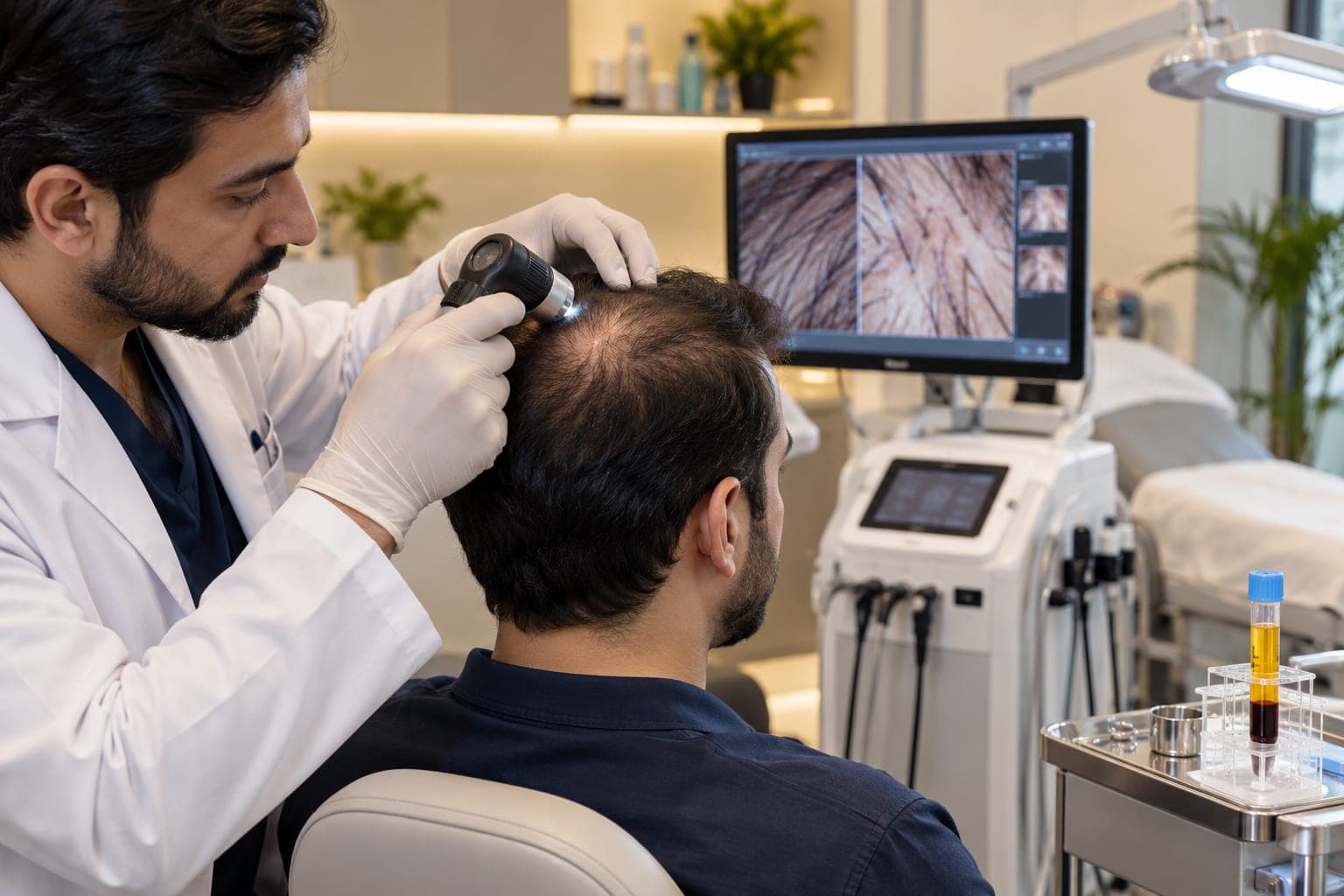
The first step is a detailed assessment of the patient's hair loss and donor area.
The doctor evaluates:
- Hairline and frontal area
- Mid-scalp and crown
- Donor-area density
- Hair thickness and quality
- Pattern and severity of hair loss
- Expected future hair loss
- Approximate graft requirements
This assessment helps determine whether a hair transplant is appropriate and which technique may be suitable.
2. Hairline Design
Hairline design is one of the most important stages of hair transplantation.
The hairline should be designed according to the patient's facial proportions, age, existing hair and available donor supply.
A natural hairline is usually designed with appropriate irregularity rather than an unnaturally straight appearance.
3. Preparation and Local Anaesthesia
Before the procedure begins, the donor and recipient areas are prepared.
Local anaesthesia is administered to minimize discomfort during the procedure. Patients remain awake during most hair-transplant procedures.
4. Graft Extraction
During FUE, individual follicular units are carefully extracted from the donor area.
The extraction process should be planned carefully to avoid unnecessary damage to follicles and excessive harvesting from one area.
Protecting the donor area is important because it may be needed for future hair restoration.
5. Graft Preparation
After extraction, the follicular units are carefully handled and prepared for implantation.
Grafts may contain different numbers of hairs, so they can be organized according to their characteristics and intended placement.
Careful graft handling is important because follicular units are delicate.
6. Recipient Area Preparation
Small recipient sites are prepared in the areas requiring hair restoration.
The direction, angle and distribution of these sites are carefully planned to match the patient's existing hair.
This is particularly important around the frontal hairline because the hair should blend naturally with the surrounding hair.
7. Graft Implantation
The prepared grafts are then implanted into the recipient area using the selected transplantation technique.
The placement is planned according to:
- Hair direction
- Hair angle
- Density requirements
- Hairline design
- Existing native hair
- Recipient-area characteristics
8. Post-Procedure Care
After the procedure, the patient receives instructions regarding scalp care and recovery.
These may include guidance about:
- Washing the scalp
- Sleeping position
- Physical activity
- Touching or scratching the transplanted area
- Prescribed medications
- Follow-up appointments
Following the clinic's post-operative instructions can help support proper healing and recovery.
9. Follow-Up and Hair Growth
Hair transplantation requires patience. The transplanted hairs do not immediately reach their final appearance.
Some transplanted hairs may shed during the early months before new growth develops. Hair density and appearance generally improve gradually over several months.
Regular follow-up allows the medical team to assess healing and progress.
Hair Transplant Recovery Timeline
Hair transplant recovery is gradual. The scalp needs time to heal, and the transplanted follicles need to go through their natural growth cycle before the final result becomes visible.
The exact recovery period varies from patient to patient, but the following timeline provides a general idea of what to expect.
First 1–3 Days
Mild redness, swelling, tenderness or sensitivity can occur around the donor and recipient areas.
Some patients may experience swelling around the forehead during the first few days. Following the clinic's post-operative instructions can help make the recovery more comfortable.
First Week
Small crusts may develop around the transplanted follicles. These gradually loosen and disappear as the scalp heals.
Patients should avoid scratching, picking or unnecessarily touching the transplanted area.
7–14 Days
The scalp usually becomes more settled during this period. Most visible crusting and redness gradually improve.
Patients can generally begin returning to their normal routine according to their doctor's instructions.
1–3 Months
Some transplanted hairs may shed during this stage. This is commonly known as shock loss or shedding and can be part of the normal hair-growth cycle.
Patients should not assume that temporary shedding means the transplant has failed.
3–4 Months
New hair growth may begin becoming visible. Initially, the new hairs can appear thin or fine.
Growth continues gradually over the following months.
4–6 Months
Hair density and coverage generally become more noticeable as the transplanted follicles continue producing new hair.
The appearance may still continue to improve significantly.
6–9 Months
Many patients notice a substantial improvement in hair coverage and density during this period.
The transplanted hair continues to mature and become thicker.
9–12 Months
The hair continues to mature, and the overall result becomes increasingly apparent.
Some patients may continue experiencing improvement beyond 12 months.
When Can I Expect the Final Hair Transplant Result?
Hair transplantation requires patience. The final result does not appear immediately after surgery.
For many patients, the result is assessed around 9–12 months, although the exact timeline varies depending on individual healing, hair-growth characteristics and the extent of the procedure.
Following post-operative instructions and attending recommended follow-up appointments can help ensure that recovery is properly monitored.
When Will You See Hair Transplant Results?
One of the most common questions patients ask after a hair transplant is, "When will I see the results?"
Hair transplantation is a gradual process. The transplanted follicles need time to establish themselves and enter their normal growth cycle. Patients should therefore not expect immediate full density after the procedure.
Hair Transplant Growth Timeline
- First month: The scalp is healing and some transplanted hairs may shed.
- 2–3 months: The transplanted follicles enter the early growth phase.
- 3–4 months: Initial new hair growth may start becoming visible.
- 4–6 months: Hair coverage and density gradually become more noticeable.
- 6–9 months: Many patients see significant improvement in density and appearance.
- 9–12 months: The transplanted hair continues to thicken and mature.
- 12+ months: Further maturation may continue depending on the individual.
Why Does Hair Take Time to Grow After a Transplant?
Hair follicles naturally go through different phases of growth and rest. After transplantation, the follicles need time to adjust to their new location and begin producing new hair.
Some transplanted hairs may initially shed while the follicle remains in place. New hair can then grow from the transplanted follicle during the following months.
Are Hair Transplant Results the Same for Everyone?
No. Hair growth and final results vary between patients.
Factors that can influence the outcome include:
- Donor hair quality and density
- Number of grafts transplanted
- Hair thickness
- Extent of hair loss
- Patient's natural hair-growth cycle
- Age and overall health
- Post-operative care
- Progression of future hair loss
For this reason, before-and-after results should always be evaluated over an appropriate period rather than judging the outcome during the first few weeks.
When Is the Hair Transplant Result Considered Mature?
Many patients can assess their result around 9–12 months after transplantation, although some individuals may continue to experience further maturation beyond this period.
A proper follow-up schedule allows the medical team to monitor healing, new growth and overall progress.
This article is general information, not medical advice. Suitability, outcomes and recovery vary between individuals and can only be confirmed after an in-person assessment.
All articles