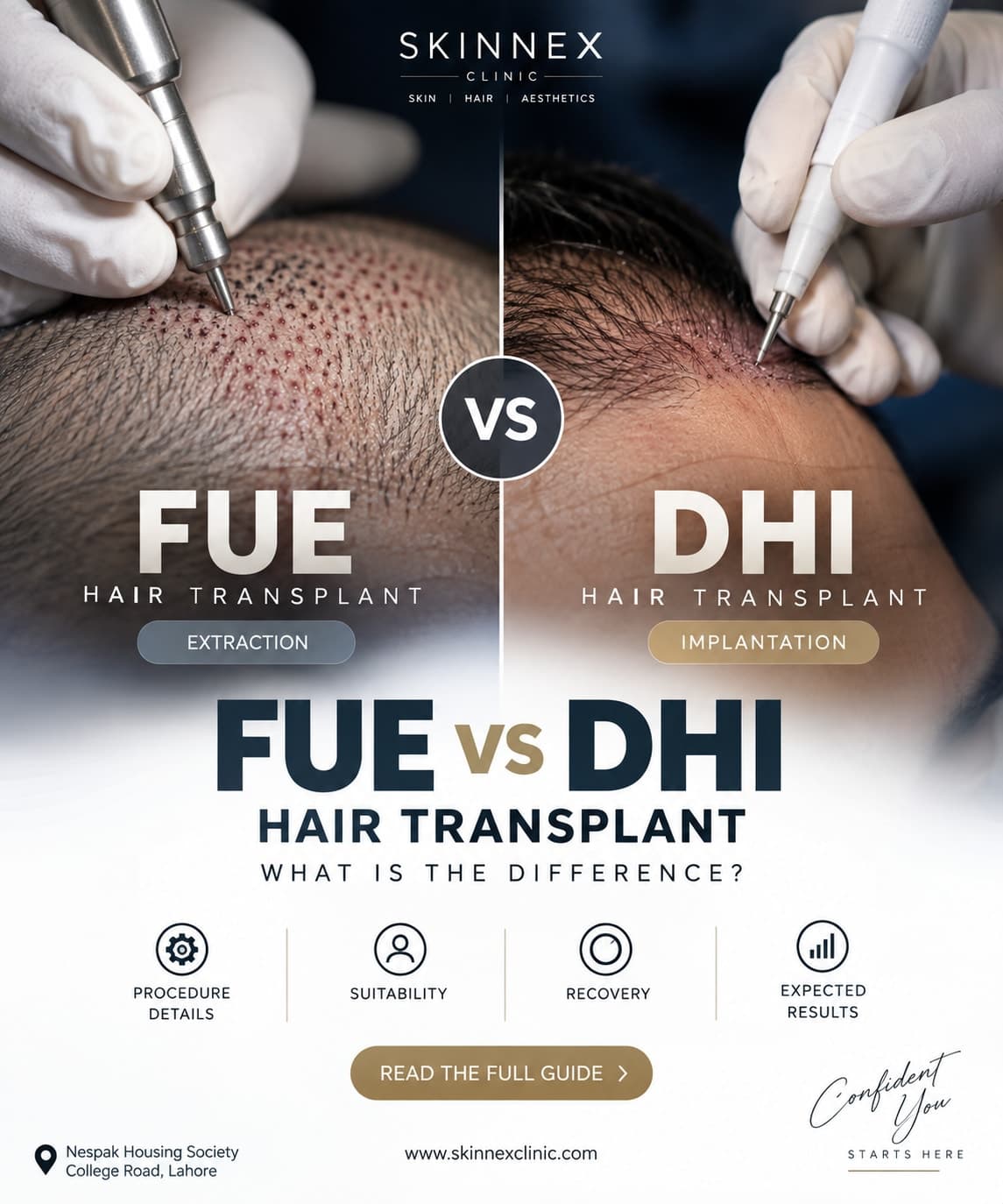
FUE and DHI are two commonly discussed hair transplant techniques, but they are not exactly the same. Learn how FUE and DHI differ in extraction, implantation, procedure planning, recovery, and suitability.
FUE vs DHI: Key Differences
Graft Extraction
Both FUE and DHI hair transplant procedures involve the extraction of individual follicular units from the donor area. The grafts are carefully harvested while considering donor density and the patient's overall hair restoration plan.
Implantation
In FUE, the recipient sites are typically prepared before the extracted grafts are placed into them. In DHI, the grafts are implanted directly into the recipient area using a specialized implantation device, allowing the placement of each graft to be carefully controlled.
Hairline Design
Both FUE and DHI require careful hairline planning according to the patient's facial features, existing hair pattern, hair loss, and long-term restoration goals. A natural-looking hairline should be designed specifically for each patient rather than using a standard template.
Suitability
FUE can be considered for various patterns and stages of hair loss, while DHI may be suitable for selected patients depending on factors such as the treatment area, donor hair availability, existing hair density, and the desired outcome. A professional assessment is important before choosing the appropriate approach.
This article is general information, not medical advice. Suitability, outcomes and recovery vary between individuals and can only be confirmed after an in-person assessment.
All articles